
STUDIO 440 | BEHIND THE FRAME
Matriarch Elephants of Nepal
These photographs were made in Chitwan National Park in Nepal, among a herd of matriarch elephants living free of chains. Elephant herds are led by their oldest and wisest females, and time spent near them changes how you look at everything else. Here is the story behind the series, told in my own voice.
A FIELD STORY BY NIKKI BAXENDALE
An intimate account of the encounter behind the photographs. Audio coming soon.
THE FIELD STORY
I spent several days in the jungles of Nepal in the company of an extraordinary group of women.
They happened to be elephants.
And I think I came away understanding a little more about what it means to be a mother, a protector and a woman.
I’d travelled to Nepal with my daughter, Chloe, to hike to Everest Base Camp. But before we disappeared into the mountains, I wanted to introduce her to another part of my world.
We travelled to Tiger Tops in Chitwan, a sanctuary surrounded by grasslands and jungle, home to a remarkable herd of female Asian elephants.
What drew me here was the philosophy behind the experience. I wanted to spend time with elephants without riding them or asking them to perform for us. I wanted to observe their relationships, walk alongside them and experience something of their world on their terms.
I remember being escorted through the tall grasses by this extraordinary group of females. There was something deeply comforting about their presence, despite their immense size. To walk alongside an animal of such enormous physical strength and experience such gentleness is something I find difficult to put into words.
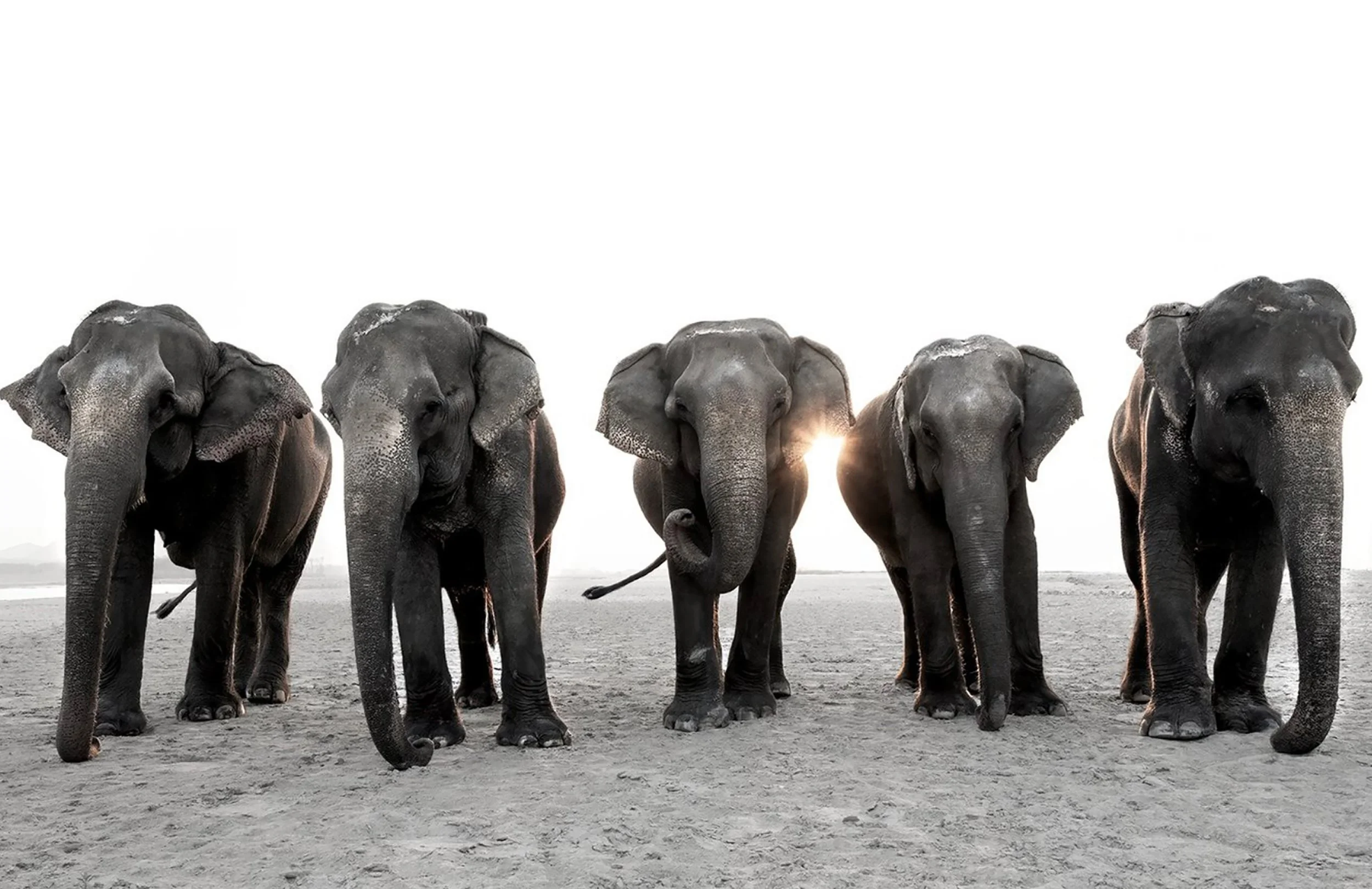
As we reached a clearing, five of them appeared, walking towards me across the open ground.
There was something so deliberate about their formation. Five magnificent females, each with her own character, her own history and her own place within the herd.
I’d learned to look at the markings on their ears, the delicate pale stippling that develops as they grow older. I loved the idea of age revealing itself in something so beautiful, almost like lace.
Their power was obvious.
What stopped me was their tenderness.
And the word that came to me was sisterhood.
Elephant society is built around the relationships between females. Their knowledge passes from one generation to the next. They remember, protect, nurture and teach. The experience of the older females is fundamental to the lives of those around them.
I found myself thinking about the women in my own life, the knowledge we pass between generations, the friendships that sustain us and the extraordinary instinct we have to protect those we love.
Perhaps having my daughter beside me made me particularly sensitive to these relationships.
One of the greatest delights of my time in Chitwan was a little elephant called Rupa Kali. She was only around six months old, and there was something wonderfully familiar about her curiosity and playfulness.
Of course, a playful baby elephant is rather different from a playful human baby, particularly when she decides to come running towards you.
I remember watching her mother gently dust her in the midday heat. Such an ordinary gesture in their world, yet I found it incredibly moving.
I recognised the instinct immediately.
As mothers, we spend so much of our lives anticipating the needs of our children, protecting them from things they haven’t yet learned to recognise, while gradually giving them the freedom to explore the world for themselves.
One day, this little elephant will become one of the older females. She will carry the knowledge of those who raised her. She will become the one keeping watch.
And as I watched her, I thought of Chloe.
There were also moments of extraordinary elegance during my time with the herd.
One of the photographs in this collection is called The Dancer. If you look closely, you’ll see her balancing on three legs, the fourth delicately crossed in front of the other. Her trunk is raised, releasing a beautiful arc of dust into the air.
For her, this was an entirely practical gesture, a way of caring for her skin.
Through my eyes, it became something almost ceremonial.
I remember being fascinated by the contrast between her enormous physical presence and the delicacy of her movement. The dust softened the light, revealing the beautiful textures of her skin and giving the entire scene an almost sculptural quality.
As both a painter and a photographer, these are the moments I find myself drawn to. I love discovering elegance in unexpected places, allowing the textures, shapes and gestures of the natural world to become the language of my work.
Every image within this collection reveals something different about these females.
Their innocence, their wisdom, their vulnerability, their grace and their extraordinary strength.
On our final morning at Tiger Tops, as the sun rose over the misty grasslands, two elephants stood on either side of our old Land Rover.
It was the most beautiful farewell.
I remember looking at them and feeling an overwhelming sense of gratitude for the few days we’d been allowed to share in their lives.
I had arrived hoping to create a collection of photographs.
I left thinking about the kind of strength I most admire.
The strength to be gentle. To protect without overpowering. To lead with experience, patience and compassion. To recognise when someone beside you needs a little more care.
When I look at these photographs now, I see so many qualities I hope to nurture in myself and pass on to my daughters.
These magnificent females reminded me how beautiful strength looks when it is accompanied by tenderness.
And perhaps, in a world so often preoccupied with power, there is something we could all learn from the matriarchs of Chitwan.